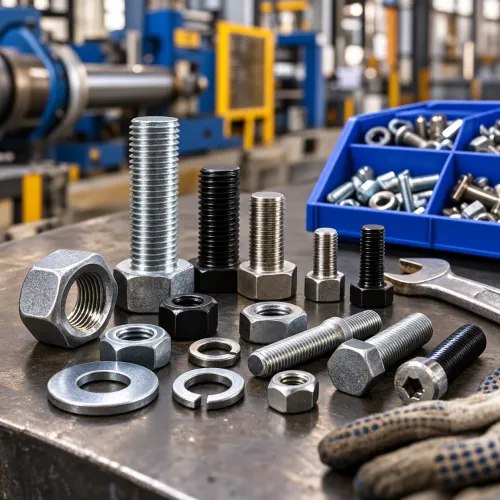
Buying Bolts for an industrial project can become complicated surprisingly quickly. Diameter and length are only the beginning. Thread specification, head style, material, grade, finish, mating nut, washer arrangement, and operating conditions may all affect whether the selected bolt is appropriate.
For procurement teams, fabricators, machinery manufacturers, contractors, and engineering companies in Pune, a structured buying process can reduce specification errors and unnecessary replacement orders.
Define the joint before requesting a quotation
The most useful starting point is the connection itself.
Ask what materials are being joined, how thick they are, whether the joint will be dismantled, and what loads or environmental conditions it will experience.
A bolt used to attach a light machine guard has a different responsibility from one used in a structural or highly loaded mechanical connection.
Where an engineering drawing specifies the fastener, purchasing teams should follow that specification rather than substituting independently.
Check diameter and length accurately
Nominal diameter determines compatibility with the corresponding hole, nut, and washer.
Length also needs careful attention. A bolt that is too short may provide inadequate thread engagement, while excessive length can interfere with surrounding equipment or make the assembly unnecessarily awkward.
Buyers should also understand how length is defined for the particular head configuration being purchased.
When replacing an existing component, measuring the original carefully is preferable to estimating dimensions visually.
Do not overlook thread pitch
Two bolts can have the same nominal diameter but different thread pitches.
If the wrong thread is paired with an existing nut or threaded component, forcing the connection can damage the threads.
Procurement descriptions should therefore include thread information whenever it is relevant, especially for machinery maintenance and replacement components.
If the existing thread cannot be confidently identified, it should be checked before bulk purchasing.
Understand bolt grade requirements
Strength classification is a critical consideration in many engineered applications.
Different grades are designed to provide different mechanical properties. A higher numerical classification should not simply be chosen because it sounds stronger; the bolt needs to match the engineered joint and mating components.
For structural, machinery, automotive-linked, or other critical applications, the specified grade should be treated as a requirement rather than a preference.
Select material and finish for the environment
Pune-based projects can range from indoor manufacturing equipment to construction sites and outdoor infrastructure.
Exposure conditions can therefore differ considerably.
Before ordering, consider moisture, chemicals, temperature, corrosion risk, and any project-specific material compatibility requirements.
Surface finish may contribute to corrosion protection or installation characteristics, but the complete specification should be reviewed rather than selecting by appearance.
Confirm the head and tool requirements
Hexagonal heads are common because they can be installed using widely available tools, but different applications may require other configurations.
Access is an important practical factor. A fastener may be technically suitable yet difficult to tighten if surrounding equipment prevents proper tool engagement.
Maintenance teams should consider how the bolt will be installed and later removed.
Build a complete purchase specification
Before approaching a supplier, prepare the key details:
- Bolt type
- Diameter
- Length
- Thread pitch where applicable
- Grade or strength requirement
- Material
- Finish or coating
- Required standard if specified
- Quantity
- Intended application
This level of detail can make quotations easier to compare because suppliers are responding to the same requirement.
Local sourcing can simplify industrial procurement
Pune's engineering and manufacturing sectors frequently require a combination of planned bulk purchases and maintenance-related fastener requirements.
Saif Nut Bolt and Hardware supplies bolts and associated fastening products for industrial and commercial customers in Pune. Sharing drawings, samples, dimensions, or clearly documented specifications where appropriate can help buyers discuss the required product efficiently.
Bolts should ultimately be purchased as specified mechanical components, not simply pieces of hardware. A disciplined approach to dimensions, threads, grades, materials, and application requirements helps reduce mismatches while supporting more predictable assembly and maintenance work.
Keywords